LOTUS DESK
University lecture hall desks are often too small and have minimal accommodation features. Students’ desks are usually filled and cramped with a laptop, iPad, and in some cases a textbook and a notebook, leaving no space for additional stationaries, phones, water bottles, and even space for scratch paper. And so, my team and I saw a product development and business opportunity to develop a foldable desk extension to cater to university students and their small lecture hall desks. The goal of this project is to create a product that resolves these aforementioned issues while blowing competition out of the water.

IDENTIFYING CUSTOMER NEEDS
The main need identified by our product mission was that the lecture hall desk was too small and did not give students enough space to work on. To validate this perceived need, each of the team members independently conducted user surveys that totaled to 57 potential users to identify key customer needs. Our interviewees were current or recently graduated university students, and so our survey catered towards our envisioned primary target market that is appropriate for our product. From the surveys, we can categorize, rank, and determine the top user needs as seen in this table.
IMAGINED USAGE SCENARIO
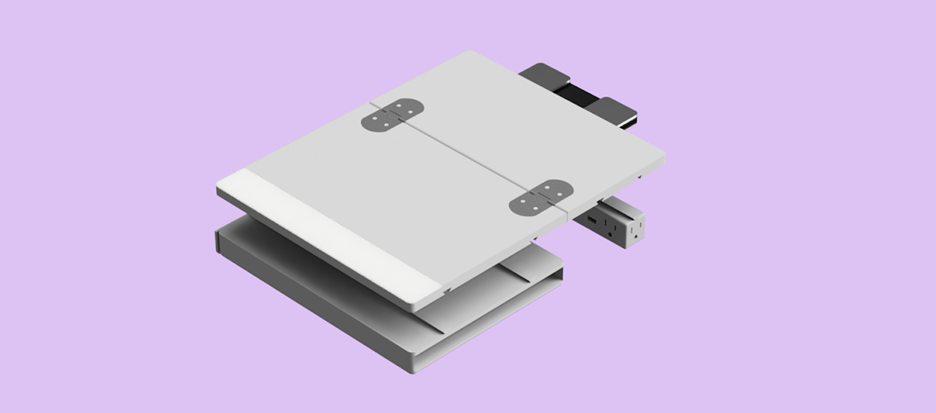
A student arrives at the lecture hall and pulls out a folded Lotus Desk that fits inside most backpacks. Once unfolded, the clamp design makes it easy to attach it before class even starts. With the desk space nearly tripled now, the student is free to keep everything right on the desk without concern for space. Users may opt for a minimal configuration for portability, but can also attach accessories such as a storage hub or a powered charging hub.

MARKET RESEARCH
Understanding the market and its competitors were crucial in tuning the product towards a successful one. As a part of our market research, my team and I conducted research on currently available solutions to our problem statement, target market, and IP research. These steps allowed us to streamline our product specifications and include differentiating features into our product, making it a cut above the competition.
As envisioned from the initial stages, college students were set as our primary target market. Based on our research, there are 19.7 million college students (BestColleges, 2021) in the US in Fall 2020, and there are 250.7 million college students around the world in 2020 and are predicted to almost double by 2040 (ICEFMonitor, 2018). In addition, we identified a secondary market of friends and family of students who would also purchase the product.

EXISTING COMPETITORS
While researching, we found one competitor called Desk Buddy which eased the concern for fierce competition in the market. Desk Buddy did not have any additional features beyond providing a small additional space by clamping to a lecture hall desk, and was arguably expensive for what it offered at $22.99. It did not solve the concerns that students have nor address all of the key needs based on our user surveys. This further validated our project purpose of creating a product that can solve all of the issues students have.
IP RESEARCH
From conducting literature reviews and IP searches, we found a few patents that inspired us to improve our product. One example is “US20030147932A1 - Self-cleaning lotus effect surfaces having antimicrobial properties” which inspired us to implement a self-cleaning coating which would make the product easy to clean. Another example is patent “US20020171271A1 Portable Desk Extension” where the folding mechanism of the product seemed to enable the existence of both space expansion and portability.

PRODUCT DEVELOPMENT
PRELIMINARY ITERATION
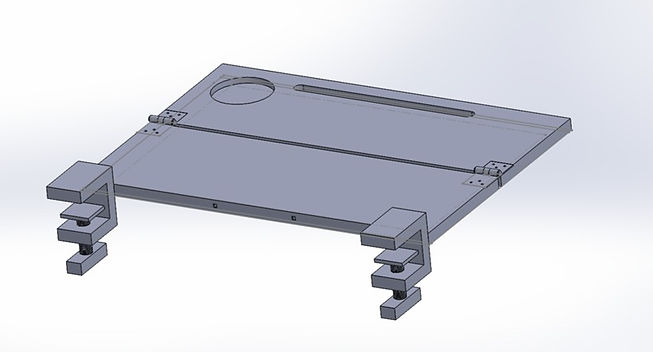
As part of the brainstorming process of our product development, my team and I each sketched multiple concepts by hand and then 3D modelled them. Here is one of the iterations that I made, modelled using SolidWorks. It features a foldable platform enabled by hinges, and clamps on to a table using two C clamps. It includes accommodation features such as the pen holder lip and water bottle cutout.
PUGH ANALYSIS
We sketched 70 concepts in total, 10 of which are my own designs, and every feature we implemented into our concepts stemmed from the key user needs that we have identified. Once we clustered all the concepts into discrete categories, we rated, ranked, consolidated, and then narrowed our sketches down to 6 using the concept selection method, Pugh Analysis. Here is the table of factors and their weights that we use for the Pugh Analysis.

FEA ANALYSIS
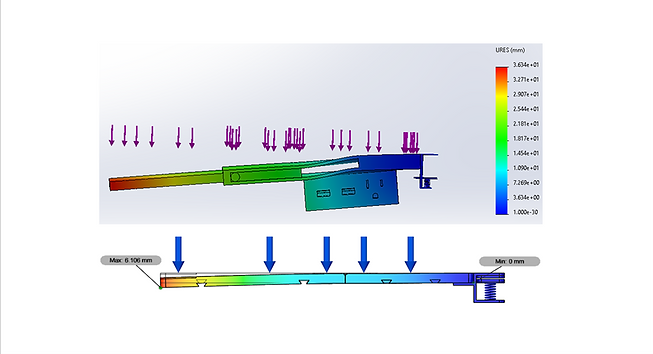
Since we were not able to test any physical prototype, we relied on CAE to validate our concepts. After narrowing down to two main concepts, sliding and folding deployment, we performed FEA to determine the concept with greater rigidity. It is concluded that the concept with folding deployment had less deflection, and so we moved on with this design.
FINAL PRODUCT


PRODUCT SPECS
Folded Dimensions = 9 x 12 x 1.5 in
Deployed Dimensions = 17 x 12 x 1.5 in
Product Lifecycle = 4 years
Weight = 2.8 lbs
Max. Load = 50 lbs
Attach/Detach Time = 3 sec
Main Material = HDPE
Surface Finish = Lotus Effect Coating